

NFL advertising effectiveness looks straightforward until you try to defend the numbers internally. Most brands measure a combined sports investment — media buy plus sponsorship — and report a single result. The problem is that advertising and sponsorship work through different mechanisms, reach fans differently, and require different proof to justify. Collapsing them into one score makes the reporting tidy and the optimization impossible.
With major sports seasons underway, understanding what empirical data reveals about brand performance versus passive reach is vital before finalizing your next media brief.
How Do Advertising and Official Sponsorships Differ in Impact?
Measurement conflation typically begins at the briefing stage. A brand secures an official league partnership alongside a live broadcast media buy, assigns them a consolidated budget, and measures the outcome as a single blended figure. While aggregate returns might appear positive, blended metrics cannot reveal which investment lever generated the return.
Broadcast advertising and official sponsorship achieve fundamentally different strategic objectives:
- Official League Sponsorship: Across 13 leagues tracked in MarketCast’s sports sponsorship effectiveness research, awareness of an official sponsorship drives an average consideration lift of more than 30 percentage points. Unlike short-term flighting, sponsorship creates a durable, compounding effect on perceived brand authority.
- In-Game Live Advertising: Live commercials operate on immediate recall and creative cut-through. MarketCast evaluates in-game creative via Brand Effect, a natural-exposure ad testing methodology that measures day-after viewer recall rather than artificial lab responses.
Breakthrough is the definitive metric for media ROI. An ad that audiences remember without correct brand attribution is merely expensive entertainment. When marketers collapse sponsorship affinity and creative recall into a single score, rigorous NFL advertising effectiveness measurement breaks down into guesswork.
Why Does NFL Advertising Effectiveness Vary Across the Season?
The Super Bowl remains the single most expensive ad environment on television, but extreme media cost does not guarantee superior audience resonance.
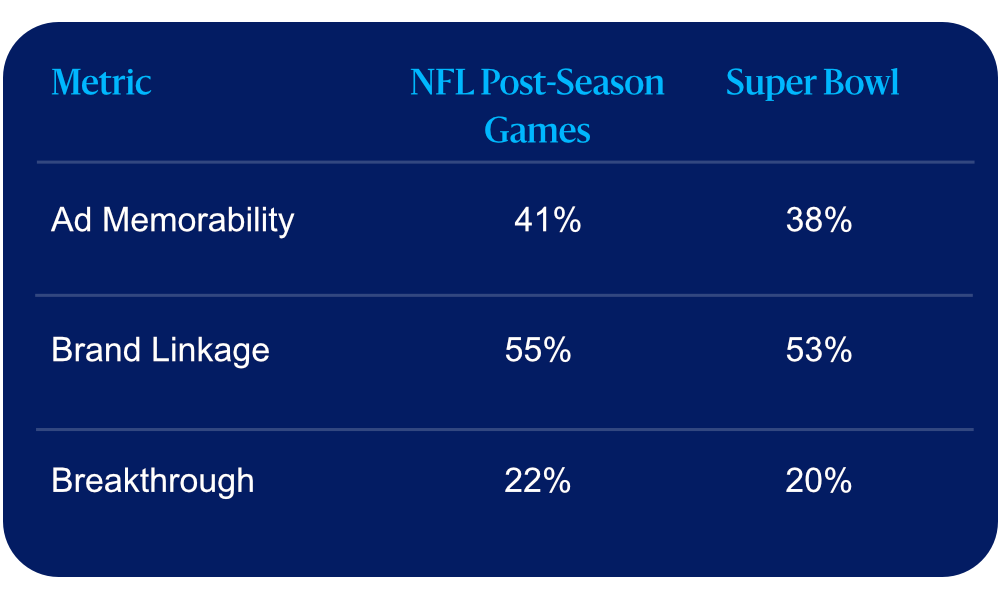
MarketCast benchmark data reveals that Super Bowl ad memorability averaged 38%, brand linkage reached 53%, and overall Breakthrough landed at 20%—falling below the prior five-year tournament norm despite broadcast rates reaching $8 million per 30-second unit. High-performing brands succeeded through creative execution rather than raw media spend alone (e.g., Budweiser’s “American Icons” achieved +47 points above norm Breakthrough via distinctive asset activation).
Crucially, regular season and playoff broadcasts offer distinct resonance profiles compared to championship games.
Post-season audiences are emotionally invested and attentive, offering an exceptional signal-to-noise ratio for brand marketers compared to casual championship viewers.
What Can Brands Learn from Cross-Platform Sports Marketing Integration?
Cross-platform research from global tournaments demonstrates how multi-channel sports integration functions at scale. In a MarketCast study tracking 10 global tournament sponsors, attribution modeling revealed how diverse levers power commercial impact:
- McDonald’s: 37% of total breakthrough generated via broadcast advertising.
- Coca-Cola: 40% of breakthrough driven directly by sponsorship resonance.
- Hyundai: 42% of breakthrough achieved through in-stadium and in-program placement.
- Home Depot: 52% of breakthrough powered by paid media creative.
Fans conscious of official partnerships demonstrated a 33-point higher consideration rate and a 23-point lift in perceived category leadership. Official sponsors outperformed non-sponsors on brand linkage by 12 percentage points (56% vs. 44%). However, non-sponsors (such as KFC and Chewy) still achieved above-norm breakthrough through distinctive contextual creative, proving that paid media and sponsorship equity operate as complementary, measurable forces.
How Can Insights Leaders Prove Sports Marketing ROI to CFOs?
Traditional TV ratings indicate the gross size of an audience, but consideration lift, category leadership shifts, and creative breakthrough quantify what actually changed in the consumer’s purchase journey. Defending rights renewals and multi-million-dollar broadcast buys requires isolating media delivery from sponsorship equity.
To build an empirical measurement framework, enterprise insights teams should apply five core principles:
- Define Objectives Upfront: Align specific outcomes (short-term sales conversion vs. multi-year brand equity) prior to selecting league assets.
- Audit Receptivity Over Reach: Evaluate fan engagement depth and emotional resonance instead of relying solely on gross impressions.
- Tailor Creative to Context: Develop custom creative that leans into specific sports storylines rather than running generic brand spots.
- Treat Synergy as a Multiplier: Integrate official sponsorship cues directly into broadcast ad creative to boost brand linkage.
- Establish Pre-Season Benchmarks: Deploy continuous campaign measurement tools prior to kickoff rather than waiting for post-campaign post-mortems.
Frequently Asked Questions About NFL Advertising Effectiveness Measurement
How is creative breakthrough measured in live sports broadcasts?
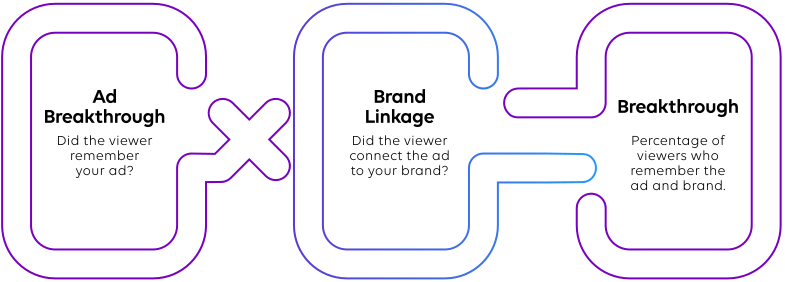
MarketCast measures creative breakthrough using day-after natural exposure ad testing. Viewers who watched the live broadcast are surveyed to determine whether they remember seeing the commercial (Ad Memorability) and whether they correctly attribute the creative to the sponsoring brand (Brand Linkage). Breakthrough represents the exact percentage of total viewers who achieve both.
What is the difference between brand memorability and brand linkage?
Brand memorability (or ad recall) measures whether an audience member remembers seeing a specific piece of creative. Brand linkage measures whether that viewer accurately connects the ad to the correct advertiser rather than a competitor. A commercial can have high memorability but low linkage if the branding cues are weak.
If your advertising effectiveness is low during live sports, what should you do?
If early in-flight measurement indicates low breakthrough, brands should evaluate brand linkage first. Low linkage is typically resolved by introducing distinctive brand assets earlier in the spot, strengthening contextual cues, or cutting secondary storylines that distract from brand attribution. Continuous in-flight measurement allows marketers to rotate creative variations before the campaign flight concludes.
Download the MarketCast Sports Playbook for Brands and get the full NFL advertising effectiveness data before your next planning cycle.