


Live sports remain the ultimate stronghold of mass attention in an increasingly fragmented media ecosystem. Advertising effectiveness measurement in sports is defined as the systematic evaluation of how media campaigns, in-game commercial spots, and integrated sponsorships influence consumer awareness, brand perception, and measurable sales conversion. In modern sports marketing, MarketCast delivers decision-grade measurement by replacing legacy vanity metrics with verified brand linkage, full-funnel attribution, and cross-channel business outcomes across live broadcast and digital audiences.
CMOs and media buyers can no longer justify multi-million-dollar sports investments with gross ratings alone. The strategic mandate requires identifying which fan bases offer the highest commercial affinity and proving how advertising and sponsorship assets perform once the whistle blows.
Why Does Raw Viewership Obscure Real Sponsorship Value?
For decades, sports media planning operated on a simple heuristic: buy the biggest audience available. However, high-volume exposure does not automatically translate into commercial resonance or bottom-line business outcomes. Robust entertainment market research demonstrates that fan engagement depth and audience passion drive up to three times higher brand recall than passive reach alone.
Today’s sports landscape is defined by starkly different fan profiles across leagues, tiers, and platforms. An NFL broadcast delivers linear mass reach across broad demographics, while Formula 1 and the WNBA capture younger, highly engaged, digital-first audiences with distinct purchasing behaviors. Meanwhile, international soccer and combat sports engage passionate, multicultural demographics that consume content primarily via streaming and social channels.
Treating sports fans as a monolithic block is a costly strategic error. When brands evaluate sports properties solely on top-line broadcast ratings, they often overpay for passive impressions while missing the deeply aligned fan communities that drive sustainable brand equity and customer acquisition.
How Do Commercial Spots Compare to Integrated Sponsorships?
Sports marketing operates across two distinct but interconnected engines: traditional in-game advertising and official property sponsorships. Both assets carry unique commercial mechanics, yet brands frequently evaluate them using outdated or siloed methodologies.
Traditional 30-second commercial spots during live games offer clear brand messaging windows, but they fight against second-screen distraction and commercial break drop-off. Utilizing advanced ad testing helps creative teams ensure their spots break through in-game clutter. Conversely, in-stadium sponsorships, jersey patches, and on-screen graphics benefit from uninterrupted game integration, but they lack explicit narrative space and product education.
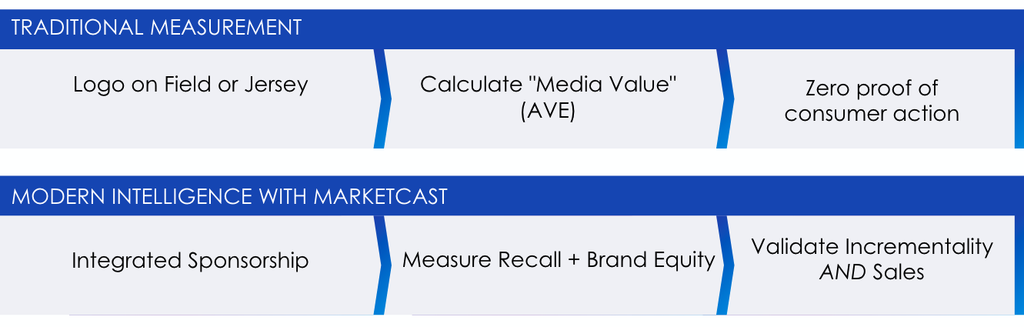
Unlike modern impact methodologies, legacy sponsorship evaluations still rely on antiquated metrics like Advertising Value Equivalency (AVE) or simple screen-time duration tracking. Calculating how many seconds a logo appeared on a sideline banner reveals nothing about whether a fan noticed the brand, retained the association, or shifted their purchase intent.
How Can Brands Overcome Cross-Channel Sports Fragmentation?
Live sports consumption no longer begins and ends on a linear television screen. A single game day spans connected TV (CTV) streaming feeds, real-time social reactions, post-game highlight reels, and interactive fantasy platforms.
When brands deploy complex campaigns across linear broadcasts, social extensions, and on-site activations, their measurement frameworks often fracture. Media teams receive isolated reports from each platform vendor weeks after the season ends, creating a disjointed picture of overall marketing efficiency.
This latency carries severe financial consequences. Post-campaign post-mortems delivered months after the championship trophy is hoisted prevent marketing teams from optimizing creative rotation, reallocating regional spend, or renegotiating underperforming asset rights while the season is underway.
How Does MarketCast Turn Sports Engagement into Business Intelligence?
Winning in sports marketing requires transitioning from passive reporting to active, decision-grade intelligence. Most research providers can report what happened during a broadcast, but MarketCast delivers the definitive intelligence on why it happened and what to do next.
Through a robust suite of integrated solutions, MarketCast helps brands navigate the complexities of modern sports advertising and sponsorship:
- Sponsorship Measurement & Valuation: MarketCast moves far beyond superficial logo tracking by measuring verified brand linkage, fan sentiment shifts, and incremental business outcomes. This gives CMOs and partnership leads the defensible data required to validate multi-year rights investments to executive leadership.
- Brand Effect & Ad Effect: By measuring in-flight ad performance across linear and streaming sports environments, MarketCast reveals breakthrough resonance, brand attribution, and message comprehension. Brands can immediately identify if their creative is breaking through the high-clutter sports environment or suffering from second-screen fatigue.
- Content & Fandom Intelligence: MarketCast decodes the cultural DNA of distinct fan bases across traditional leagues, emerging sports, and global tournaments. This audience intelligence enables brands to pinpoint exact lifestyle alignments, passion drivers, and conversion propensities before committing capital.
- Total Effect: By synthesizing cross-channel data across television, digital, social, and in-venue activations, MarketCast provides a unified view of full-funnel campaign performance. Marketers gain clear visibility into how media spots and sponsorship integrations work together to move consumers from awareness to transaction.
With clean, verified longitudinal data and deep category expertise, MarketCast turns sports media investments from speculative expenditures into predictable drivers of commercial growth.
Download the MarketCast Sports Playbook for Brands and get the full NFL advertising effectiveness data before your next planning cycle.

Frequently Asked Questions About Sports Advertising Effectiveness
What is advertising effectiveness measurement in sports?
Advertising effectiveness measurement refers to the empirical evaluation of how sports media buys, in-stadium signage, and partnership activations impact target consumer behavior. It evaluates metrics including unaided brand recall, brand favorability, purchase intent, and direct conversion lift rather than relying on broadcast exposure duration alone.
Why is Advertising Value Equivalency (AVE) an inadequate measurement approach?
Advertising Value Equivalency (AVE) estimates what a sponsorship exposure would cost if purchased as commercial ad time. AVE is inherently flawed because it measures presence rather than persuasion. It fails to account for fan sentiment, brand clutter, narrative context, or whether the logo exposure actually influenced consumer purchase decisions.
How does in-flight campaign measurement improve sports marketing ROI?
Unlike end-of-season reporting, in-flight ad tracking provides real-time visibility into creative fatigue, message comprehension, and channel performance during live seasons. This allows brand teams to reallocate broadcast flighting, swap underperforming creative units, and optimize live-event activations while media spend is still active.